
The Evolution of Digital Marketing: From Banners to AI
Introduction
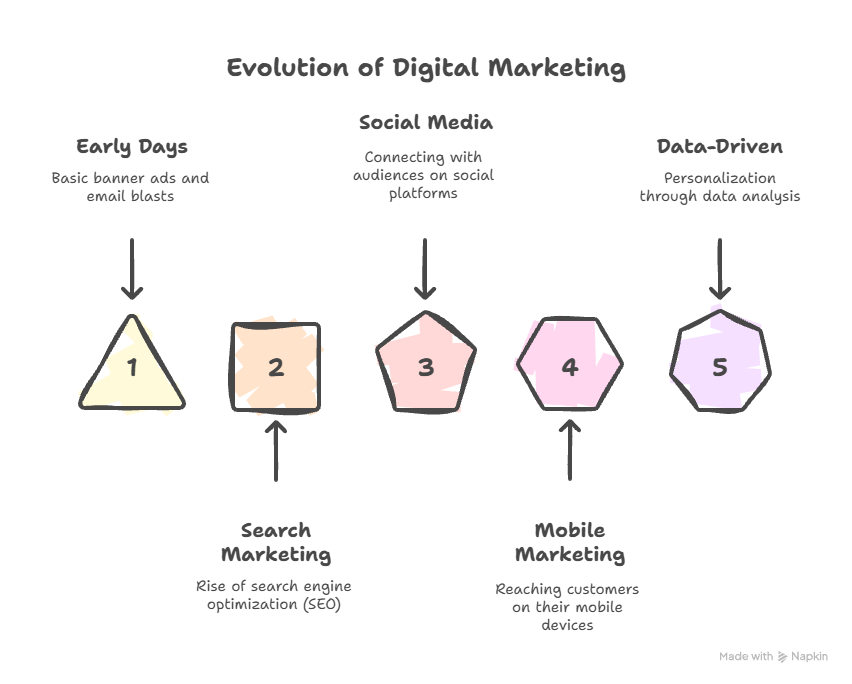
Digital marketing has undergone a dramatic journey. What began with the first clickable banner ads and basic email blasts in the early days of the internet has evolved into a complex ecosystem powered by data, automation and artificial intelligence (AI). Understanding this transformation is not just historical interest—it helps marketers, business owners and professionals anticipate where the field is headed and how to adapt.
In this article, we trace the evolution of digital marketing — from banners to search, social, mobile, data-driven personalization and now AI — and explore what this means for the future.
Early Days: Banners, Email & the Dawn of Online Advertising
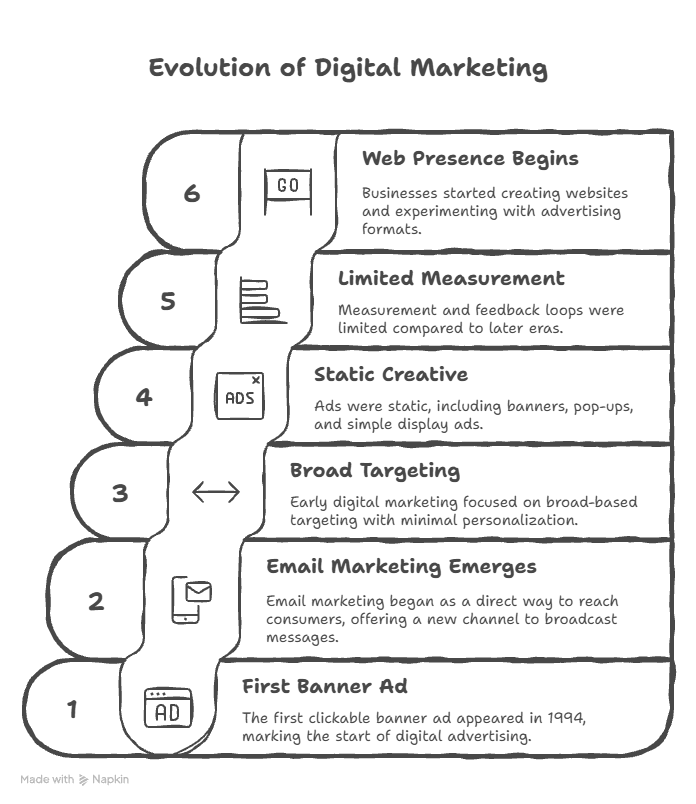
In the 1990s, as the internet became accessible and the web browser gained ground, brands began experimenting with simple online ads. The first clickable banner ad appeared in 1994, signalling the start of digital advertising in earnest.
Email marketing also emerged as a direct way to reach consumers, offering a new channel to broadcast messages. With limited targeting and analytics compared to today’s standards, the focus was on awareness and reach.
Key characteristics
Broad‐based targeting, minimal personalization
Static creative: banners, pop-ups, simple display ads
Limited measurement and feedback loops compared to later eras
Beginning of web presence: businesses creating websites, experimenting with advertising formats
This era laid the foundation: marketers realised the internet was not just a static medium but a place consumers could be reached.
Search & Performance Era: SEO, PPC and Measurable Results
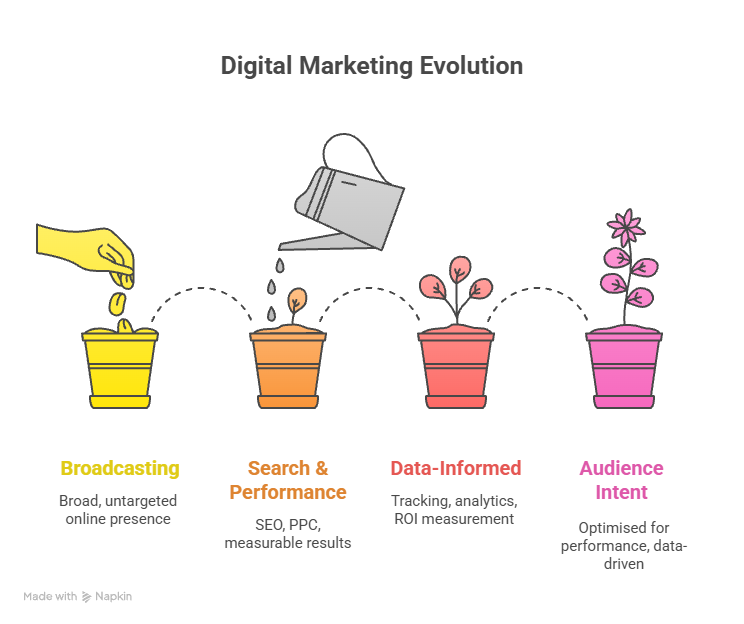
As web usage grew and search engines matured (Yahoo, Google), companies discovered that being discoverable online mattered. The rise of search engine marketing (SEM), pay-per-click (PPC) and search engine optimisation (SEO) allowed brands to move from “broadcasting” to “being found”.
Turning points
-
SEO evolved: keyword optimisation, link building, site-structure improvements
-
PPC introduced performance-based advertising (you pay when someone clicks)
-
Better tracking and analytics began emerging: you could measure visits, conversions, ROI
This phase marked a shift from “just being present online” to “optimising for audience intent and performance”. Marketing became more data-informed, results-oriented.
Social, Mobile & Content Era: Engagement, Communities & Experience
With the growth of social media platforms, smartphones and mobile internet, digital marketing entered a phase of deeper audience engagement and multi-channel experiences. Users were no longer passive; they interacted, shared, created. Content marketing, influencer marketing and mobile optimisation became vital.
Key developments
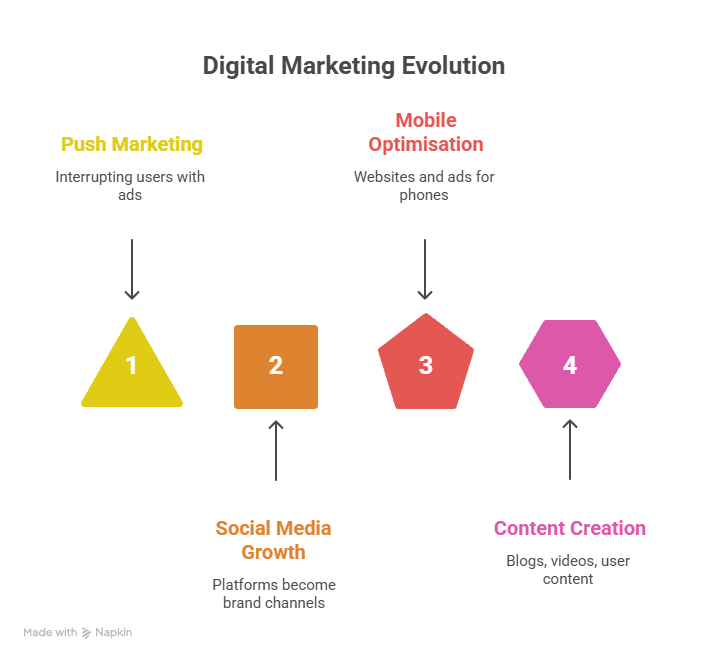
Social platforms (e.g., Facebook, YouTube, Instagram) became brand-channels and community hubs
Mobile first became essential: websites, ads, experiences optimised for phones
Content became central: blogs, video, user-generated content, storytelling
Marketing moved toward building relationships, not just interrupting users
In this era, digital marketing shifted from “push” to “pull”: instead of just showing ads, brands aimed to engage, create value, and build loyalty.
Data & Personalisation Era: Big Data, Automation & Customer Centricity
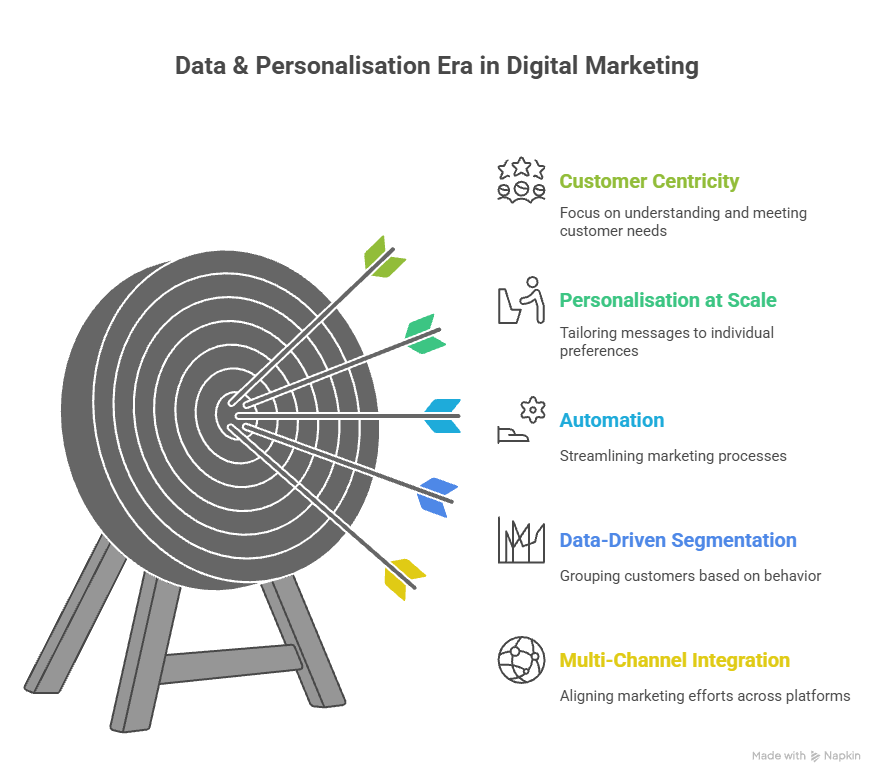
As technology matured, marketers gained access to richer data and analytics. Tools for marketing automation, segmentation, predictive analytics emerged—enabling more personalised, targeted campaigns.
Features of this era
Data-driven segmentation: understanding individual consumer behaviour
Automation: email workflows, retargeting, dynamic content
Personalisation at scale: messages tailored to user behaviour, preferences
Multi-channel integration: aligning website, mobile, email, social
The big lesson here: audience insight and relevance matter. The more you know your customer, the better you can deliver experiences that resonate—and the better the returns.
AI & the Future: Machine Learning, Personalisation and Autonomous Marketing
Today — and increasingly in the future — digital marketing is being transformed by AI, machine learning, and advanced automation. According to research, the use of AI in digital marketing is expected to grow significantly by 2025.
What this means in practice
AI-powered tools for content creation, predictive analytics and audience segmentation
Chatbots and conversational interfaces that engage users in real time
Real-time optimisation of campaigns, bidding, messaging
Hyper-personalised experiences: tailoring not just ads, but entire journeys for individuals
Emerging tech: voice search, AR/VR, immersive experiences
As one source puts it, marketing is shifting from human-crafted campaign cycles to machine-augmented continuous optimisation.
Why This Evolution Matters for Your Strategy
Understanding this evolution isn’t just academic. It helps you:
Recognise which marketing tactics are now outdated and which are future-proof
Build strategies that align with where consumer behaviour and technology are heading
Avoid being reactive: instead map a path through phases of transformation
Prioritise investment: knowing where to focus — e.g., data infrastructure, AI readiness, mobile optimisation
In short, if you only use “banner ad thinking”, you’ll struggle in a world of AI and customer expectations for personalised, meaningful experiences.
Challenges and Considerations
Even as digital marketing becomes more advanced, there are important challenges:
Privacy and data regulation: With greater data use comes greater responsibility. Compliance and consumer trust matter.
Technology adoption and skills: AI and automation aren’t plug-and-play—companies need infrastructure and talent.
Keeping the human touch: In a world of automation, authenticity, brand values and storytelling remain crucial.
Integration across channels: A fragmented approach (separate teams for social, email, search) won’t cut it. One unified customer view is needed.
Staying agile: Technology and consumer behaviour evolve rapidly—what works today may not tomorrow.
Conclusion
The journey of digital marketing — from simple banner ads to cutting-edge AI-driven campaigns — is a story of technology, consumer behaviour, and strategic evolution. For marketers and business leaders, the real opportunity lies not in chasing each new tool but in understanding the broader arc: how we moved from broadcast to discovery, from mass to personalised, and from static to autonomous.
As you build your digital marketing strategy, ask yourself:
Are you still relying on tactics from a previous era?
Is your data infrastructure ready for personalised experiences?
Are you prepared to integrate AI, automation and immersive tech in a thoughtful way?
The future of digital marketing belongs to those who adapt, learn, and remain customer-centric while embracing technology.